Professional Guide | Full Process of Sewage Treatment Operation Cost Accounting, Easy to Master for Beginners!
In the operation of sewage treatment projects, cost accounting is the core link for controlling project benefits and realizing refined management. Accurate cost accounting not only makes operating expenses transparent but also provides a scientific basis for process optimization and cost control. Kaiya Environmental Protection has deepened its roots in the environmental protection field and accumulated rich practical experience in sewage treatment operation. Now we sort out the practical knowledge of the full process of sewage treatment operation cost accounting, comprehensively disassemble the accounting logic from core formulas to itemized accounting, and from practical steps to key points for avoiding pitfalls, enabling beginners to quickly understand and apply it.
Core Accounting Formula: Identify the Calculation Benchmark
The operation cost of a sewage treatment plant refers to all expenses directly linked to the treated water volume in daily operation. The core accounting formula is easy to understand, which can be calculated on an annual, quarterly or monthly basis. The key is to keep the accounting cycle of expenses and water volume consistent:
Unit operation cost (Yuan/ton of water) = Total operation cost (total expenditure in the accounting cycle) ÷ Treated water volume in the accounting cycle (ton)
Five Core Cost Components: Detailed Accounting Points for Each Item
The sewage treatment operation cost is mainly composed of five core sectors, each with a general industry proportion range. Accounting shall cover all necessary items to ensure no omissions and accurate calculation.
1. Energy Consumption Cost (30%-50% of the total)
As the largest proportion of operation cost, the accounting scope includes the electricity fees of all electrical equipment in the whole sewage treatment process (excluding special processes, no coal/ fuel oil costs). The core power-consuming equipment includes lift pumps, aeration systems (accounting for 40%-60% of total energy consumption), sludge return pumps, mixers, dehydrators, disinfection equipment, etc.
Accounting formula: Energy consumption cost = Total power consumption × Electricity price; Total power consumption = Single equipment power (kW) × Daily operation time (h) × Accounting days × Number of equipment × Load rate (0.7-0.9 in general industry).
2. Chemical Reagent Cost (10%-20% of the total)
The accounting covers the chemical reagent fees of all links including pretreatment, biochemical treatment, advanced treatment and disinfection. Common reagents and their core functions are: PAC (Polyaluminium Chloride, for coagulation and precipitation to remove suspended solids/colloids), PAM (Polyacrylamide, as a coagulant aid to accelerate sludge settlement), Sodium Hypochlorite/Chlorine Dioxide (for disinfection and sterilization, with better safety than traditional liquid chlorine), acid-base reagents (to adjust the pH of sewage to the suitable range of 6-9 for biochemical processes).
Accounting formula: Chemical reagent cost = Daily consumption of all reagents × Unit price of reagents (Yuan/kg) × Accounting days; Daily consumption of reagents = Daily treated water volume (m³) × Reagent dosage (mg/L) ÷ 1000 (unit conversion from milligram to kilogram).
3. Sludge Disposal Cost (10%-15% of the total)
The accounting scope includes the whole process costs from dewatered sludge (moisture content about 80%) to final disposal, excluding the depreciation of sludge treatment equipment (equipment depreciation is included in equipment cost). The mainstream disposal methods are outward transportation and landfilling, drying + incineration/resource utilization (the latter is more environmentally friendly with a slightly higher cost than landfilling). The general industry sludge yield (moisture content 80%) is about 0.05-0.1 ton per cubic meter of water.
Accounting formula: Cost of outward transportation and landfilling = Daily sludge output × (transportation unit price + landfill disposal fee) × Accounting days; Cost of drying + incineration/resource utilization = Drying energy consumption cost + incineration/resource utilization processing fee.
4. Labor Cost (15%-25% of the total)
The accounting covers the full-caliber salary and welfare of all on-the-job personnel in the sewage treatment plant, including wages, social security, housing provident fund, overtime pay, training fees, labor protection articles, etc. Personnel allocation is scientifically planned according to the project scale: less than 10,000 tons of daily treatment, 3-5 people (factory director + operator + maintenance worker); 10,000-50,000 tons, 8-15 people (adding laboratory technicians and dispatchers); more than 50,000 tons, more than 20 people (shifting in teams).
Accounting formula: Labor cost = Annual salary per person × Total number of employees.
5. Other Operation Costs (5%-10% of the total)
It refers to the necessary daily operation expenses except the above four items. The accounting scope includes: equipment maintenance fees (spare parts, maintenance labor, equipment calibration fees); laboratory test fees (reagents for water quality monitoring such as COD, ammonia nitrogen and total phosphorus, consumables for laboratory test equipment); office and miscellaneous fees (water and electricity fees in office area, office supplies, communication fees, site rental fees); taxes and fees (value-added tax and surcharges calculated after policy reduction and exemption).
Accounting method: It can be summarized according to the actual occurrence amount. Beginners can first estimate 5%-10% of the total cost of the above four items, and gradually make it accurate according to the actual operation data later.
Three-Step Practical Method to Complete Cost Accounting
Step 1: Collect Basic Data
Core data collection: daily designed treated water volume, actual treated water volume in the accounting cycle (avoid the deviation between designed volume and actual volume); Supplementary data collection: equipment list and power, electricity price, unit price and dosage of chemical reagents, sludge output and disposal unit price, number of employees and their salaries, bill vouchers such as maintenance fees and laboratory test fees.
Step 2: Calculate Each Cost Item by Item
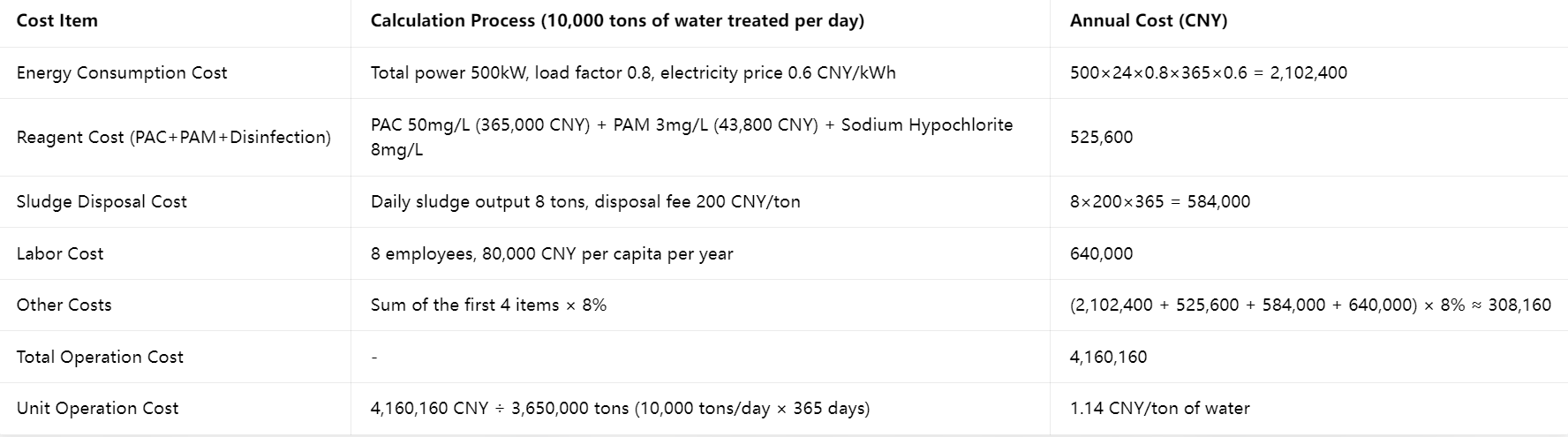
Calculate the cost of each of the five sectors (energy consumption, chemical reagents, sludge, labor, others) by applying the corresponding accounting formulas respectively, and keep good data accounting records.
Step 3: Verification and Adjustment
Check whether the unit operation cost is within the reasonable industry range (1.0-1.8 Yuan/ton for small sewage treatment plants, 0.8-1.5 Yuan/ton for medium-sized ones, 0.6-1.2 Yuan/ton for large ones); if the actual treated water volume is lower than the designed volume, allocate fixed costs such as labor and part of equipment energy consumption according to the actual water volume to avoid inflated costs.
Beginner's Guide to Avoiding Pitfalls in Accounting
Do not omit the equipment load rate: Equipment does not operate at 100% full load, and calculating electricity fees directly according to the rated power will overestimate the actual energy consumption cost.
Adjust the reagent dosage according to the actual water quality: When the concentration of incoming water pollutants is high (e.g., COD>500mg/L), the reagent dosage needs to be increased accordingly, and accounting cannot be based only on the designed value.
Include all links in the accounting of sludge disposal fees: In addition to transportation fees, the disposal fees of landfills/incineration plants are the core expenditure, which is easy to be omitted and must be fully included.
Clearly distinguish between operation cost and total cost: Operation cost does not include equipment depreciation and loan interest. If it is necessary to calculate the total project cost, depreciation expenses and financial expenses need to be added additionally.
Kaiya Environmental Protection always adheres to promoting the operation and management of sewage treatment projects with a professional and scientific concept. From cost accounting to process optimization, from on-site operation to technical support, we provide customers with a full-process and integrated environmental protection solution. In the future, Kaiya Environmental Protection will continue to share practical knowledge in the environmental protection industry, help industry partners improve their operation and management level, and realize a win-win situation of environmental and economic benefits.
Related News
With more than 10 precision production lines, we have an excellent technical and design team to provide you with high-quality products with preferential prices.
Privacy Policy
Tel: 400-9926-919
E-mail: zhangshuangandyss@gmail.com
Address: Building 4, Innovation and Entrepreneurship Industrial Park Economic Development Zone, Taizhou City, Jiangsu Province